How accurate are golf simulators, really?
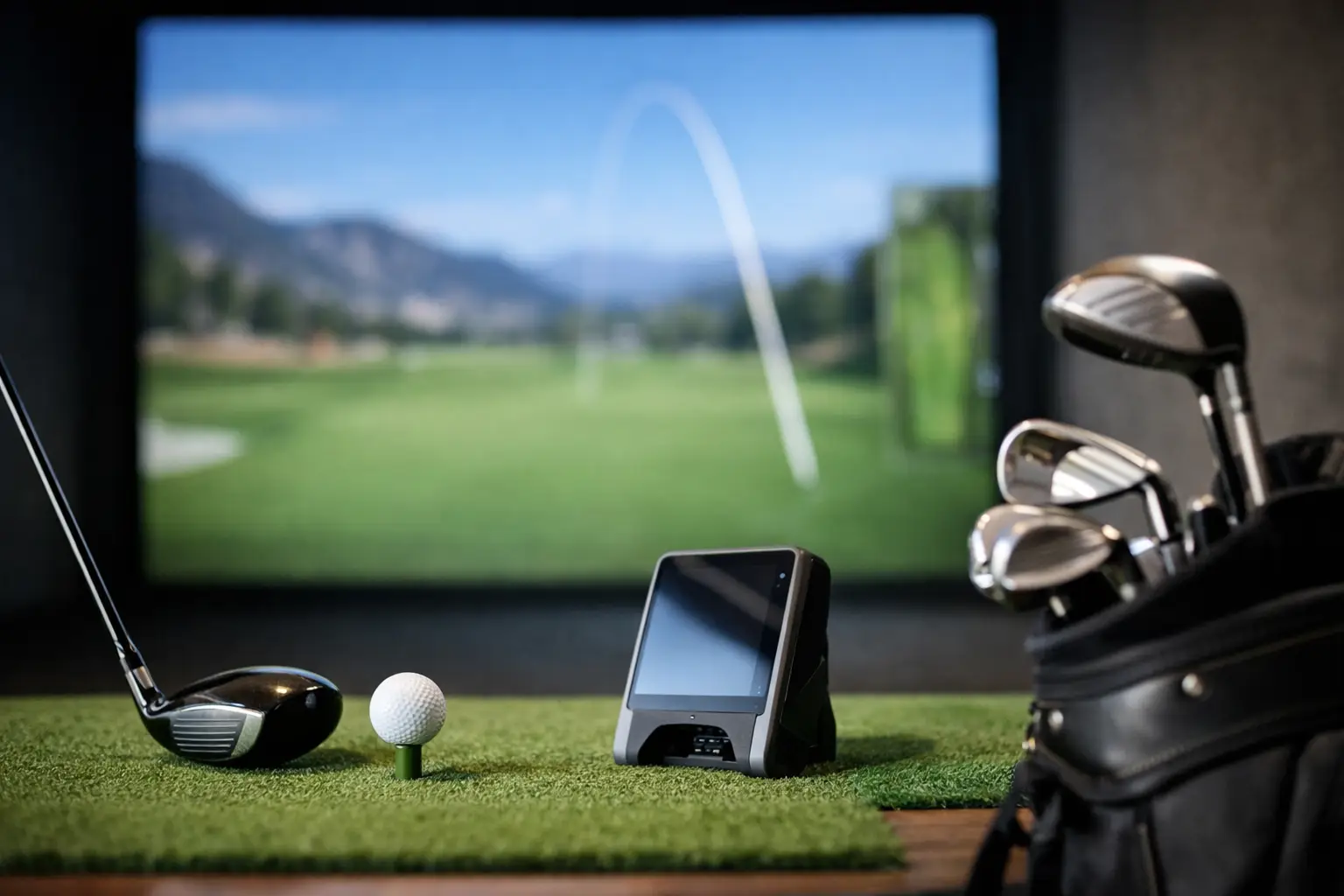
“How accurate is it?” is the first question every serious golfer asks about a simulator, and it usually gets a marketing answer. Here is a more useful one.
The honest version is that accuracy is not one number. A simulator measures some things directly, calculates others from what it measured, and models the rest. The quality of a bay depends on which category each number falls into.
What is measured versus what is inferred
Broadly, systems split into two families.
Club-data systems
These read the clubhead — speed, path, face angle, attack angle — and then calculate what the ball probably did. When the strike is clean and central, the calculation is good. When you catch it thin, off the toe, or off a bad lie, the model is working from assumptions that your actual strike just violated.
Ball-data systems
These read the ball itself after impact — speed, launch angle, spin, direction. The flight is derived from what the ball is genuinely doing rather than from what the club suggests it ought to do. Mishits are where the difference shows up, and mishits are most of golf.
The bays at 24 Precision Golf run GOLFZON TwoVisionNX, which captures the ball at impact at 400 frames per second. That is the ball-data approach.
Mishits are where simulators disagree with reality. Mishits are also most of golf.
The variable nobody talks about: the lie
Here is the accuracy question that matters more than any sensor spec, and almost nobody asks it.
What are you standing on?
On a course, you are almost never level. The ball is above your feet or below them, you are hitting up a slope or down one, and your body compensates before you have consciously noticed. That compensation is a real part of the shot.
On a flat mat, none of that exists. You can have a perfectly accurate launch monitor producing perfectly accurate numbers for a shot you will essentially never face on a golf course.
The TwoVisionNX puts the stance on a moving swing plate with 64 positions covering up to 56,000 lies. The floor tilts to the lie you drew. This is not a comfort feature — it is an accuracy feature, because it stops the bay training a swing that only works on carpet.
Which numbers should you actually trust?
A reasonable hierarchy, most trustworthy first:
- Ball speed. Directly measured on a ball-reading system. Trust it.
- Launch angle and direction. Also directly observed. Trust it.
- Spin. Measured on good systems, but sensitive to ball condition and markings. Trust the trend more than any single reading.
- Carry distance. A model, fed by the measurements above. Reliable for comparing your own clubs against each other; less reliable as an absolute number to quote in a bar.
- Total distance. Carry plus modelled roll on modelled turf. Treat as indicative.
The practical rule: simulators are excellent at relative truth and weaker at absolute truth. If the bay says your 7-iron carries 12 yards further than your 8-iron, believe it. If it says your driver goes exactly 271 yards, treat that as a well-informed estimate.
How to test a bay in one session
You do not need to take anyone’s word for it. Book an hour and run this:
- Hit ten shots with one club. Look at the spread, not the best one. A good bay shows you a realistic dispersion pattern, not ten identical results.
- Deliberately hit one thin and one off the toe. The screen should show you a bad shot that looks like the bad shot you felt. If mishits mysteriously fly straight, the system is modelling rather than measuring.
- Compare gaps, not distances. Check that your club gapping matches what you know from the course. If the gaps are right, the bay is telling you the truth about your bag.
- Play a hole you know well. If you know the course, you will feel immediately whether the elevation and roll-out behave.
Does simulator practice transfer to the course?
It transfers best when the practice is not flat and not mindless. Two hundred balls from a level mat with no target trains a stance and a routine you will never use. Playing a real course on a plate that tilts, choosing clubs and living with the result, trains the thing you actually do on Saturday.
The equipment here is the same platform the GOLFZON Global Tour competes on, which is a reasonable external check on whether the numbers are taken seriously by people with something at stake.
If you want the specifications rather than the reasoning, they are on the technology page.
Related questions.
How accurate are golf simulators?
Accuracy depends on whether the system measures the ball directly or calculates flight from club data. Ball-reading systems, like the GOLFZON TwoVisionNX at 400 frames per second, stay closer to reality on mishits. Simulators are strongest at relative comparisons between your own clubs and weaker as absolute distance authorities.
Do golf simulators help your real game?
They transfer best when practice is not flat and not mindless. A moving swing plate that reproduces real lies keeps your setup honest, which is the part that carries to the course.
What is a swing plate?
A floor section under your stance that physically tilts to match the lie. The TwoVisionNX uses 64 positions covering up to 56,000 lies, so an uphill lie changes your actual stance.
Are simulator distances real?
Carry distance is modelled from directly measured ball data, so it is reliable for comparing your clubs to each other and indicative as an absolute number.
Test it yourself for an hour.
Sources and further reading
- Launch-monitor measurements and specifications TrackMan
- TwoVisionNX simulator features GOLFZON
- GOLFZON simulator technology GOLFZON