How to Practice Golf Indoors and Improve
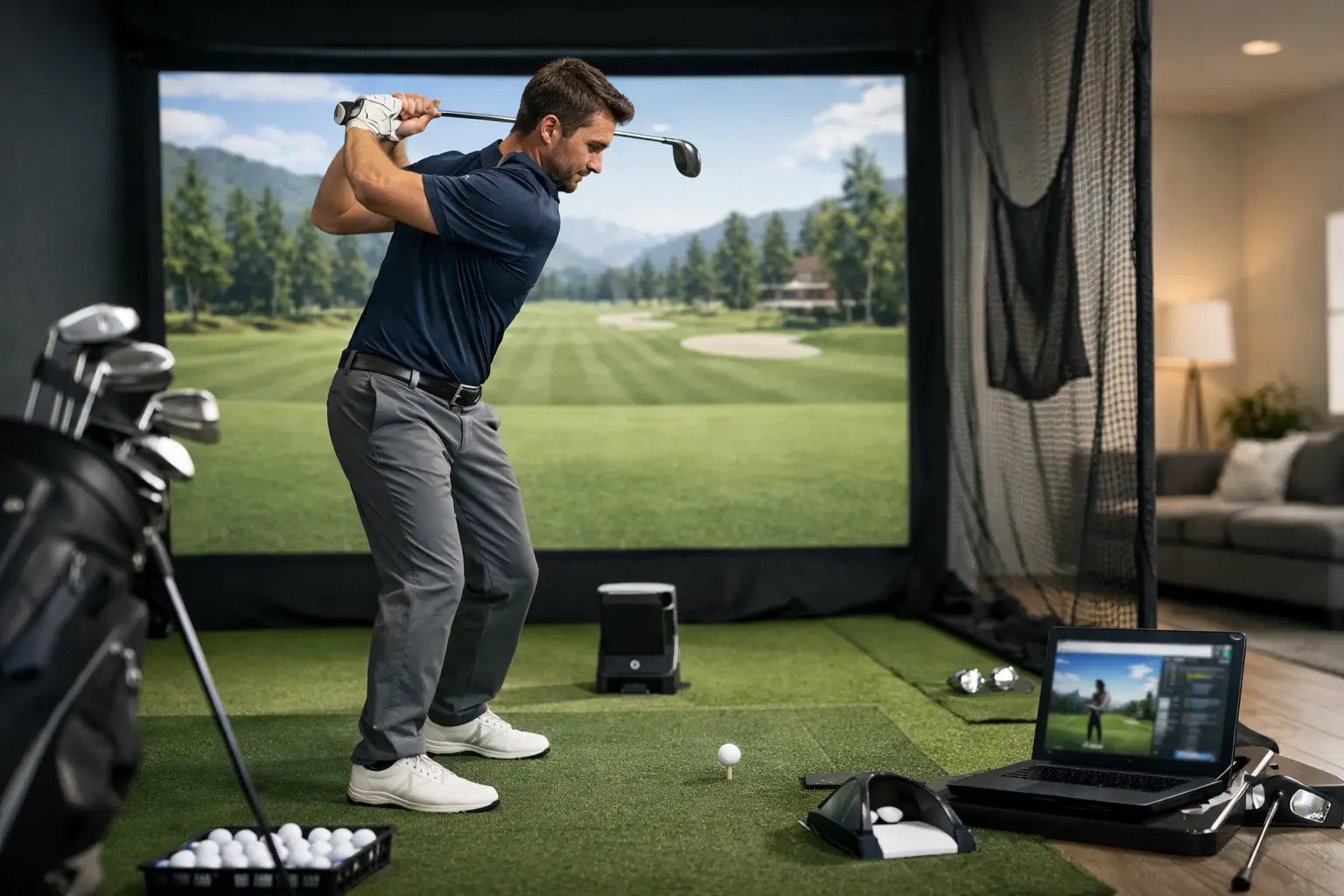
A lot of bad indoor golf practice looks productive right up until you get back on the course. You hit ball after ball into a net, your swing feels fast, and then the first real approach shot starts left, climbs too high, and comes up short. If you want to know how to practice golf indoors in a way that actually transfers, the goal is not just swinging more. The goal is creating feedback, structure, and realistic reps.
Indoor practice can be one of the fastest ways to improve because it removes friction. No weather delays, no wasted time driving to the range, and no guessing whether that session helped. But the quality of your setup matters. A mirror in the garage helps with positions. A net helps with contact. A high-end simulator adds the missing layer most golfers need – precise ball data, realistic lies, and visual feedback that tells you what the club and ball are actually doing.
How to practice golf indoors without building bad habits
The biggest mistake golfers make indoors is practicing only what feels satisfying. Full swings usually win because they look athletic and sound impressive. The problem is that swing volume without feedback can groove the wrong move just as efficiently as the right one.
A better indoor session starts with a purpose. Some days that means face control with a short iron. Other days it means low-point control, driver start lines, or wedge distance consistency. Practice gets sharper when you define the skill before you start hitting shots.
This is also where realism matters. Flat mats and perfect lies can hide issues you will absolutely see on the course. If you have access to a premium simulator environment with multi-surface hitting mats, moving swing plates, and high-speed impact cameras, indoor work stops feeling like a compromise. It starts feeling like useful training.
Start with the right kind of feedback
Not all indoor setups do the same job. If your only tool is a net, you can work on tempo, balance, and strike awareness, but you cannot reliably judge start direction, spin, carry, or dispersion. That does not make a net useless. It just means you need to be honest about what it can and cannot teach.
Launch monitor and simulator data change the equation. When you can see carry distance, club path, face angle, launch, spin, and impact location, you stop guessing. You can test whether a swing thought actually improves your pattern instead of deciding based on feel alone.
For many golfers, this is the difference between random hitting and real practice. Advanced systems such as Golfzon’s TwoVisionNX go even further by adding moving swing plates, 400 FPS impact cameras, auto-tee functionality, and surface changes that make uphill, downhill, rough, and bunker conditions feel closer to outdoor golf. That level of feedback is especially useful if your goal is to improve, not just stay loose.
If you practice at home
Keep your home setup simple and specific. A mirror, an alignment stick, a putting mat, and a net can cover a lot if you use them intentionally. Film your swing occasionally so you can compare what you feel with what is real.
If space is limited, lean into skills that do not require full ball flight. Grip checks, setup rehearsals, takeaway work, impact drills, and short putting can all pay off quickly. Indoor practice does not need to be elaborate to be effective.
If you practice in a simulator bay
Use the technology. Too many golfers book simulator time and then ignore the data. Pick two or three numbers that matter for the club you are working on. For example, with wedges, focus on carry and launch windows. With driver, pay attention to start line, spin, and strike location.
The smartest approach is usually narrow, not broad. One clear objective produces better results than trying to fix your entire game in an hour.
Build your indoor practice around the shots that save scores
Most golfers think they need a prettier swing. More often, they need better contact, tighter distance control, and fewer penalty shots. Indoor practice is perfect for all three.
Wedge play and distance control
This is where indoor golf shines. Pick three wedge distances and build a stock motion for each. Then test your carry numbers repeatedly. If your 50-yard shot sometimes flies 43 and sometimes 58, that is not a technique issue alone. It is a calibration issue.
A simulator helps because carry distance is measured, not estimated. Over time, you can create reliable scoring windows instead of relying on instinct. That translates directly to lower scores because wedge play is one of the few areas where precision matters more than power.
Contact and low-point control
You do not need a full course to improve ball-first contact. Place a small reference point just ahead of the ball position and train yourself to strike the ball before the turf line. On mats, pay attention to strike quality rather than assuming every shot was solid just because the club bounced through.
This is one reason high-end indoor environments are more useful than basic mats. Better surface interaction gives you more honest feedback. When lies change and the platform moves with the shot, you learn to adapt instead of rehearsing only one perfect condition.
Driver start lines and face control
If your driver misses are expensive, indoor work can clean them up fast. Start by narrowing the goal. Do not chase max speed for an entire session. Train start direction first, then strike location, then ball speed.
A simple benchmark is whether you can start eight out of ten drives within your intended window. If you cannot, your on-course strategy is being built on unstable mechanics. Indoor data makes that obvious quickly.
Do not ignore the short game just because you are inside
Indoor putting and chipping are often treated like filler. They should not be. Putting, in particular, responds well to structured indoor reps because the variables are controlled.
Start with face control on short putts. If you cannot start a five-footer on line indoors, the course will not magically fix it. Then move to pace training from longer distances. Even if your mat cannot perfectly recreate green speed, you can still train consistent strike and start line.
For chipping, focus on landing spot awareness and club selection. If you have access to dedicated short-game space, use it to rehearse different trajectories instead of hitting the same standard chip over and over. Variety matters because real golf rarely gives you one stock lie and one stock shot.
Keep sessions shorter and more focused than you think
Long indoor sessions can become sloppy. Fatigue sets in, attention drops, and the last 40 swings are often worse than the first 20. A sharp 45-minute session with a clear theme is usually better than two hours of unfocused hitting.
Try dividing practice into blocks. Start with five to ten minutes of setup and movement work. Spend the middle of the session on your primary skill. Finish with a challenge that adds pressure, such as hitting a carry number three times in a row or completing a fairway target test before you leave.
That final piece matters. Practice should include consequence. Otherwise, it stays comfortable and rarely transfers.
Know when indoor practice is enough and when it is not
Indoor golf can cover far more of the game than many players realize, especially when the technology is strong and the environment is built for realism. You can improve mechanics, contact, face control, wedge distance, course management, and even competitive sharpness through simulator rounds, leagues, and structured games.
Still, there are limits. Wind management, uneven natural turf interaction, and the emotional rhythm of outdoor golf are harder to replicate perfectly. That does not reduce the value of indoor training. It just means the smartest players use it for what it does best – efficient, measurable improvement.
If you are serious about getting better, the ideal setup is one that combines convenience with accurate feedback. That could mean a disciplined home station for daily reps and a premium simulator facility for data-driven sessions, lessons, and realistic play. In the Phoenix metro area, that is exactly why golfers use spaces like 24 Precision Golf – not just to hit balls indoors, but to train with purpose in an environment that reflects real performance.
The indoor routine that actually works
A practical weekly plan is simple. One session for wedges and short game. One for full-swing pattern work. One for simulated on-course play where every shot has a target and a consequence. If you can add instruction, even better, because expert eyes paired with accurate technology can shorten the trial-and-error phase dramatically.
The key is consistency. Indoor golf gives you access. Access gives you repetition. But only focused repetition moves the needle.
The best indoor practice does not try to imitate every part of outdoor golf. It sharpens the parts that matter most, measures them honestly, and sends you back to the course with more control than you had before.