Indoor Golf vs Driving Range: Which Fits?
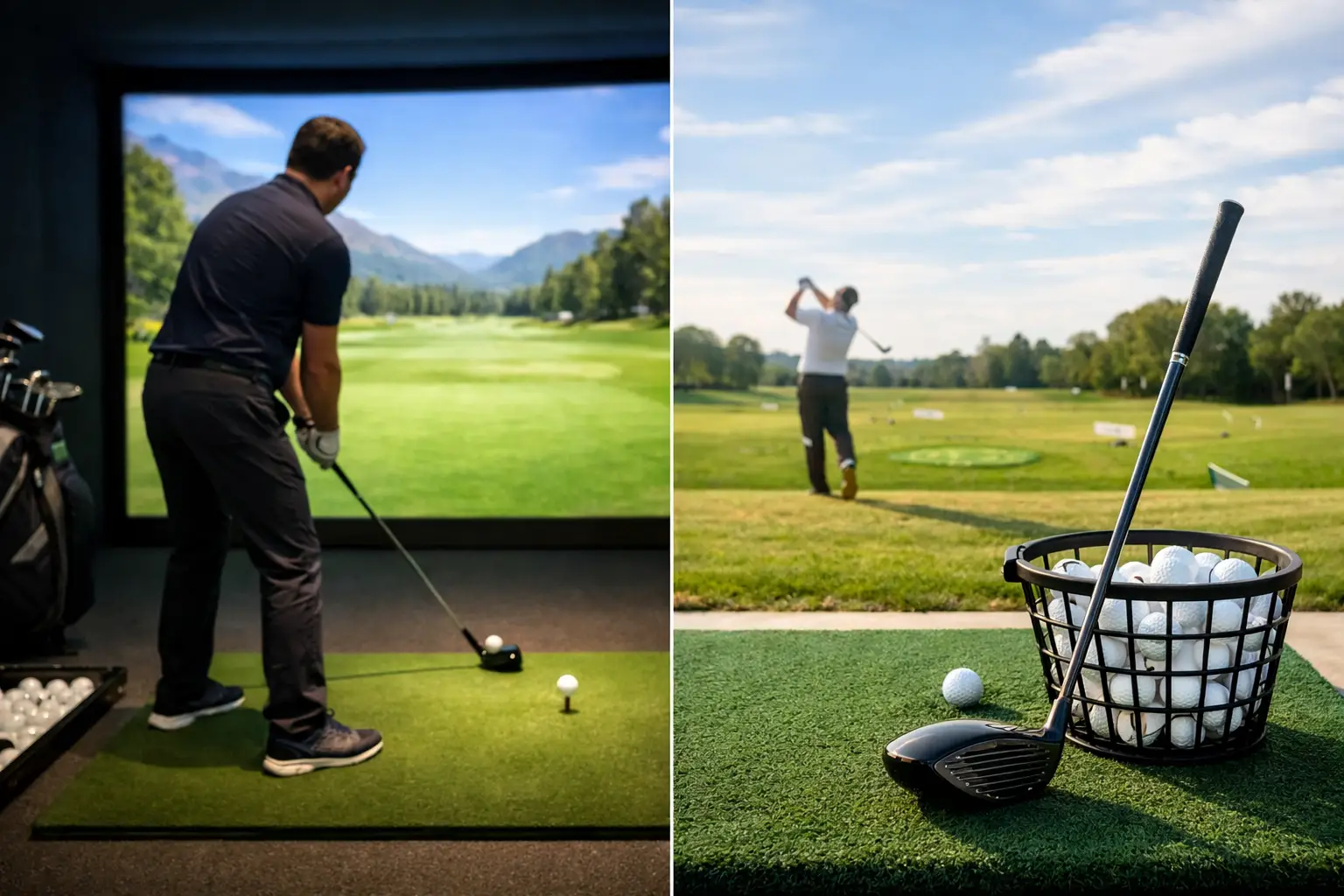
A bucket of balls can tell you a lot. It can also hide a lot. If you have ever walked off a driving range feeling dialed in, then struggled to take that same swing to the course, you already understand why indoor golf vs driving range is not a simple either-or debate.
Both can help your game. Both can waste your time if you use them the wrong way. The better question is not which one is universally better. It is which environment gives you the kind of feedback, repetition, and playing conditions that match what you are trying to improve.
Indoor golf vs driving range: the real difference
At a basic level, the driving range gives you ball flight in open space. Indoor golf gives you measured ball data and simulated play in a controlled environment. That distinction matters more than most golfers think.
A traditional range is familiar for a reason. You can see the shot shape, feel the club move through real air, and hit a lot of balls quickly. For players who like to practice by feel, that visual freedom can be useful. There is also a simplicity to it. Grab clubs, pick a target, start swinging.
Indoor golf changes the equation by replacing guesswork with information. A high-level simulator can show launch angle, spin, carry distance, club path, face angle, ball speed, and dispersion. That means you are not just reacting to whether a shot looked good. You are learning why it behaved the way it did.
For golfers who want to improve efficiently, that difference is significant. Seeing a draw is helpful. Knowing whether it came from path, face, strike, or spin is better.
When the driving range works best
The driving range still has clear advantages, especially for golfers working on rhythm, warm-up routines, or basic contact. If you want to loosen up before a round, test a swing thought, or get comfortable hitting full shots outdoors, the range does that well.
There is also value in watching the whole shot fly without a screen involved. For some players, that visual feedback builds confidence. You can track trajectory with your eyes, pick distant targets, and vary clubs without thinking too much about numbers.
But range practice has limits. Most ranges do not tell you exact carry versus total distance. Mats can mask poor contact. Wind can distort what you think your stock shot is. Range balls rarely perform like premium balls on the course. And unless the facility offers tracking technology, much of the session depends on your own interpretation.
That is fine for maintenance practice. It is less fine when you are trying to make measurable swing changes.
Where indoor golf pulls ahead
Indoor golf is strongest when precision matters. If your goal is to improve with purpose instead of just hit balls, a quality simulator setup creates a more useful practice environment than many golfers expect.
The biggest reason is consistency. Indoors, there is no wind, no heat fatigue, no fading light, and no uneven setup from one stall to the next. You can compare swings under the same conditions and trust the feedback. That makes it easier to identify patterns instead of chasing random outcomes.
The technology also raises the ceiling. Advanced simulator systems can capture impact at high speed, measure the ball and club in detail, and recreate a much more lifelike playing environment than older indoor setups. Features like moving swing plates and multi-surface hitting mats matter because they force you to adjust to uphill, downhill, fairway, rough, and bunker conditions rather than grooving a single flat lie all session.
That is where premium indoor golf becomes more than entertainment. It starts to resemble structured training.
Indoor golf vs driving range for skill development
If you are focused on skill development, indoor golf usually gives you more actionable information per swing. That does not mean every golfer needs data overload. It means useful feedback shortens the path between problem and correction.
Take distance control. On a range, many players think they hit a 7-iron 165 because they once saw one land near the 165 sign. Indoors, you can separate occasional best shots from true average carry. That changes club selection, gapping, and course management.
The same goes for strike quality. A shot can look decent on a range and still be a low-face strike that loses spin or speed. High-speed impact cameras and ball-tracking data expose that immediately. For serious players, juniors, and anyone taking lessons, that kind of visibility is hard to beat.
Instruction also tends to be more effective indoors when the technology is integrated well. A coach can connect what you feel, what the video shows, and what the numbers confirm. That creates a cleaner learning loop than verbal advice alone.
The realism question
Some golfers hear “simulator” and think arcade. That depends entirely on the facility.
A basic simulator bay built for casual fun is not the same as a performance-driven indoor golf environment. Better systems now offer highly accurate ball tracking, realistic course graphics, auto-tee functionality for faster sessions, and hitting surfaces that change based on the lie. When paired with moving plates and precise shot measurement, the result feels far closer to real golf than most people assume.
Does that make indoor golf a complete replacement for outdoor play? No. You still need to manage real weather, turf interaction, green reading, and the mental side of being on an actual course. But if the question is whether indoor practice can be realistic enough to sharpen your swing, improve your distances, and simulate meaningful on-course decisions, the answer is yes.
In many cases, it is more realistic than a standard range mat and a field full of limited-flight balls.
Convenience changes how often you practice
The best practice format is the one you will actually use consistently. This is where indoor golf has a major edge for busy adults, families, and anyone trying to fit golf into a packed schedule.
A weather-proof, climate-controlled facility removes many of the excuses that kill repetition. You are not deciding whether the heat is too much, whether the wind will ruin the session, or whether sunset cuts your practice short. You can book time, arrive with a plan, and get quality reps without the friction that often comes with outdoor practice.
That matters in Arizona, where year-round golf is available but not always comfortable. In peak summer, an indoor session can be the difference between productive practice and no practice at all.
Convenience also extends to the experience itself. Auto-tee systems speed things up. Simulated course play gives groups a way to practice and compete without committing half a day. For many golfers, that blend of efficiency and realism makes indoor golf easier to sustain long term.
What about cost?
Driving ranges often win on entry price. A bucket is usually cheaper than booking simulator time, and that matters if all you want is volume. If your goal is to make a lot of swings for the lowest possible cost, the range is hard to beat.
But cost per session is not the only lens. Value matters too. If an indoor hour gives you better feedback, more focused reps, and clearer improvement, it may be the more efficient investment. That is especially true for golfers working with instructors, preparing for tournaments, or trying to make specific changes instead of just staying loose.
Memberships, leagues, and structured programming can also shift the equation. A premium facility that combines simulator access, coaching, short-game work, and organized play often delivers more than a standard practice stop. That is why places like 24 Precision Golf appeal to both serious players and social groups. The environment supports improvement, but it also makes the time feel elevated and enjoyable.
Which one should you choose?
If you love seeing full outdoor ball flight, want a quick warm-up, or simply need low-cost reps, the driving range still has a place. It is familiar, accessible, and useful for keeping your swing moving.
If you want precise feedback, realistic simulated play, year-round consistency, and a more structured path to improvement, indoor golf is often the smarter choice. It is especially strong for lessons, club gapping, focused practice, league play, and golfers who value performance data over guesswork.
For many players, the best answer is not indoor golf or driving range. It is using each one for what it does best. Hit the range when you want outdoor feel. Train indoors when you want clarity, consistency, and measurable progress.
The smartest practice is not the one that feels the most traditional. It is the one that tells you the truth about your game and makes you want to come back tomorrow.
Sources and further reading
- Golf participation and industry facts National Golf Foundation
- Motor learning in golf: a systematic review PubMed
- GOLFZON simulator technology GOLFZON