What Does Club Path Mean in Your Golf Swing?
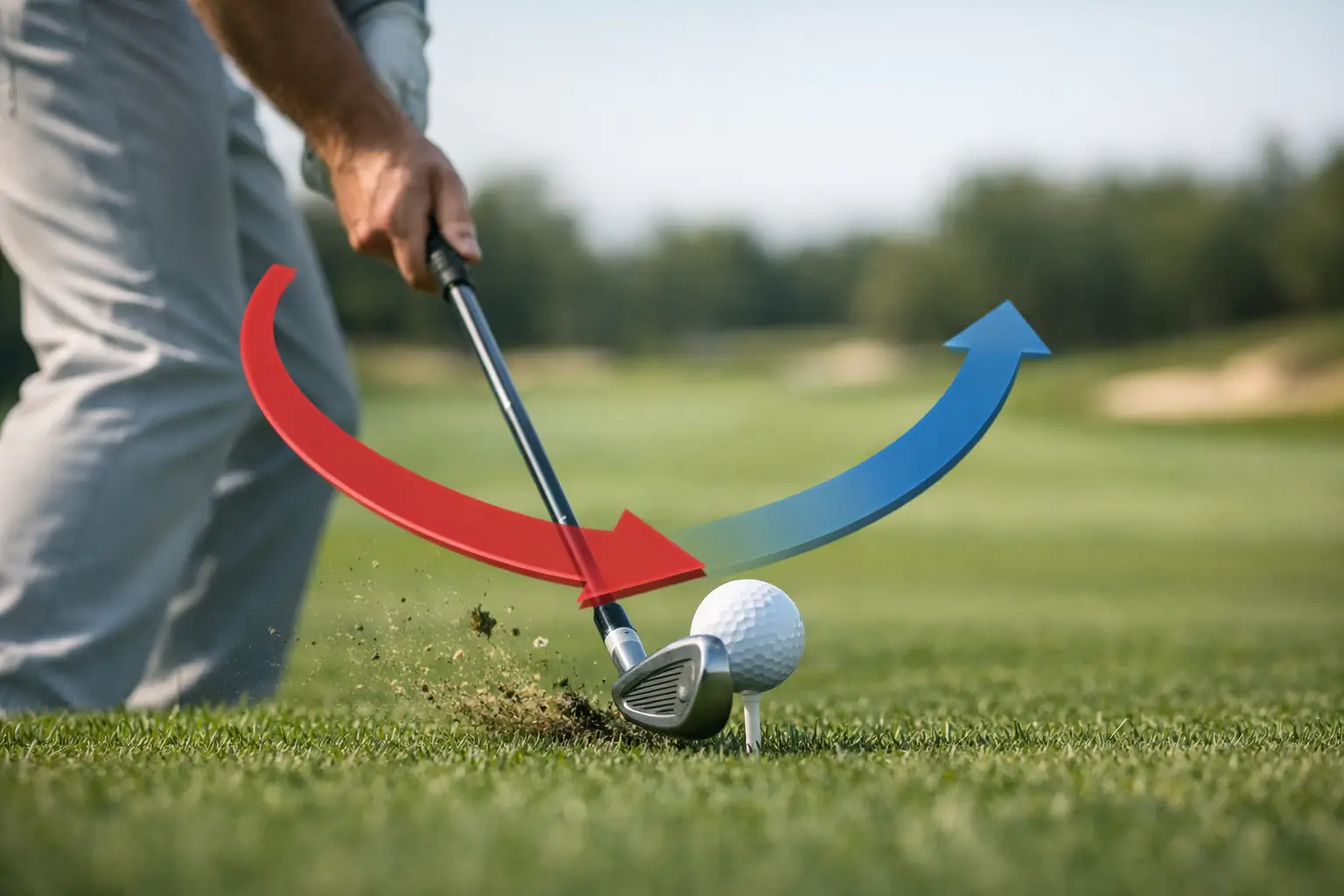
A ball that starts right and curves farther right is not just “a slice.” It is evidence. Once you understand what does club path mean, the numbers on a simulator stop feeling like technical clutter and start giving you a practical explanation for the shots you see on the course.
Club path is one of the most useful swing measurements for golfers who want more than a guess at why a shot moved the way it did. It helps explain draw and fade patterns, but it is only one part of the impact picture. Read it alongside clubface, strike location, and attack angle, and you have a far more complete route to better golf.
What Does Club Path Mean?
Club path is the direction the clubhead is traveling horizontally through impact relative to your target line. It is usually displayed in degrees.
For a right-handed golfer, a positive club path means the clubhead is moving to the right of the target line at impact. This is commonly called an in-to-out path. A negative club path means the clubhead is moving left of the target line, often called an out-to-in path. A path near 0 degrees means the clubhead is traveling close to neutral relative to the target line.
For left-handed golfers, the directional labels reverse. The useful idea remains the same: club path tells you whether the club is moving toward one side of the target line or the other when it meets the ball.
A club path of +3 degrees, for example, means the clubhead is traveling 3 degrees to the right of the target line for a right-handed player. That number does not automatically mean you will hit a draw. The clubface position relative to that path determines much of the ball’s curve.
Club Path Is Not the Same as Clubface Angle
This distinction matters. Clubface angle describes where the face is pointing at impact. Club path describes where the clubhead is moving.
In most full shots, the clubface has the biggest influence on where the ball starts. The relationship between face angle and path has a major influence on how the ball curves. If the face is open relative to the path, the ball tends to fade or slice. If the face is closed relative to the path, it tends to draw or hook.
Consider a right-handed golfer with a path of +3 degrees and a face angle of +1 degree. The club is moving right, but the face is less right than the path, making the face closed relative to the path. That is a common draw-producing relationship. If the same player has a path of +3 degrees with a face angle of +5 degrees, the face is open relative to the path, which can produce a push-fade.
The goal is not necessarily a zero club path. The goal is a path and face relationship that creates your intended ball flight consistently.
Why Club Path Matters for Your Ball Flight
Club path offers a clear window into the pattern behind your misses. A right-handed player who repeatedly sees a negative path and an open face relative to that path is likely to produce a fade or slice. A player with an excessively positive path and a face that closes too quickly may see pulls, draws, or hooks.
This is why the old advice to simply “swing out to right field” can be incomplete. For some golfers, it may help shift an overly leftward path. For others, it can make a positive path too extreme and create a new problem. The best adjustment depends on the complete impact pattern, not one number viewed in isolation.
Club path can also affect contact. A player who approaches the ball dramatically from the outside may struggle with heel contact, steep divots, or glancing blows. A player who swings too far from the inside may get stuck, flip the hands, or catch shots off the toe. These are tendencies, not rules, but they are useful clues when a ball-flight issue and strike pattern show up together.
The Same Path Can Produce Different Shots
A +2-degree path can produce a tight draw, a straight push, or a push-fade depending on the clubface. A -2-degree path can produce a controlled fade, a straight pull, or a pull-hook if the face is too closed relative to the path.
Strike location adds another layer, especially with the driver. A toe strike can add draw curvature, while a heel strike can add fade curvature because of gear effect. That means a driver that curves right is not always caused by an out-to-in path. The face-to-path relationship and impact location both deserve attention.
This is where accurate feedback changes the practice conversation. Instead of trying five different swing thoughts after a poor drive, you can identify whether the primary issue is path, face, contact, or a combination of all three.
What Is a Good Club Path Number?
There is no single ideal number for every golfer, every club, or every intended shot. A player who wants to hit a reliable stock fade may perform well with a slightly leftward path and a face that is modestly open relative to it. A player who prefers a draw may favor a slightly rightward path with a face that is a touch closed relative to that path.
For many golfers, a club path within a few degrees of neutral is a useful starting point. It gives the player room to manage curvature without requiring a dramatic face angle. But a number that looks “perfect” on screen is not valuable if it does not produce repeatable contact, a predictable start line, and a shot shape you can trust under pressure.
The club also matters. Driver swings often have a different path and attack-angle profile than mid-iron swings. With a driver, a golfer may intentionally swing more upward and slightly from the inside to support a high-launching draw. With an iron, the priority may be a more neutral delivery that controls low point and distance.
Your target line matters, too. Launch-monitor systems calculate club path relative to a selected target. If your alignment is off, or if you are aiming for a specific shot shape but evaluating the number against the wrong target line, the data can be misleading. Good practice starts with a clear target and an honest understanding of what shot you are trying to hit.
How to Use Club Path Data in Practice
Start by watching patterns, not chasing a single swing. Hit a meaningful sample of shots with the same club, then compare your average path, average face angle, strike location, launch direction, and curvature. One unusual swing is noise. A repeated pattern is actionable information.
If you are working on a slice, do not assume the fix is purely a more positive path. First, determine whether the face is open to the target, open to the path, or both. A player whose path is already +4 degrees but whose face is +7 degrees does not need to swing farther from the inside. That player needs better face control relative to the path.
If your miss is a pull-draw or hook, look for an overly closed face relative to a path that may already be rightward. In that case, forcing the path more left may not solve the issue if the face remains excessively closed. Your best adjustment may be grip, release pattern, setup, alignment, or a more appropriate swing intention.
At 24 Precision Golf, simulator-based practice lets golfers see this feedback shot after shot in a controlled setting. Golfzon technology, including high-speed impact cameras and realistic hitting conditions, makes it easier to connect the data with the feel of the swing and the quality of contact. That is far more productive than trying to diagnose a ball flight from memory after a range session.
Practice With a Specific Ball-Flight Goal
Give each practice block a purpose. Choose a target, choose the shot shape you want, and use the numbers to confirm whether your delivery matches the plan. A golfer trying to hit a small draw might work toward a slightly in-to-out path with a face that is just closed relative to that path. A golfer building a stock fade might do the opposite.
Avoid making large changes from one swing to the next. Start with setup and alignment, then test one athletic feel at a time. For a player with a steep, out-to-in pattern, a coach may use a drill that encourages the club to approach more from the inside. For a player who is too far in-to-out, the solution may involve improving rotation and getting the club moving more left through impact. The right drill depends on the golfer.
When Club Path Is Not the Main Problem
Club path is valuable, but it does not explain every poor shot. Fat and thin contact can be more closely tied to low-point control. Inconsistent distance may come from strike quality, dynamic loft, or speed. A ball that starts wildly offline may point first to face angle or alignment.
It is also possible to have a path that looks efficient on a launch monitor but still struggle on the course because the motion is not repeatable under pressure. That is why the best practice combines precise measurement with target-based games, changing lies, and purposeful repetition.
Think of club path as a diagnostic tool, not a grade on your swing. The number becomes useful when it helps you produce a shot you can repeat. Build a ball flight you understand, then give yourself enough quality reps to trust it when the round is on the line.
Sources and further reading
- Club-data definitions TrackMan
- Launch-monitor measurements and specifications TrackMan