How Simulator Feedback Lowers Scores Faster
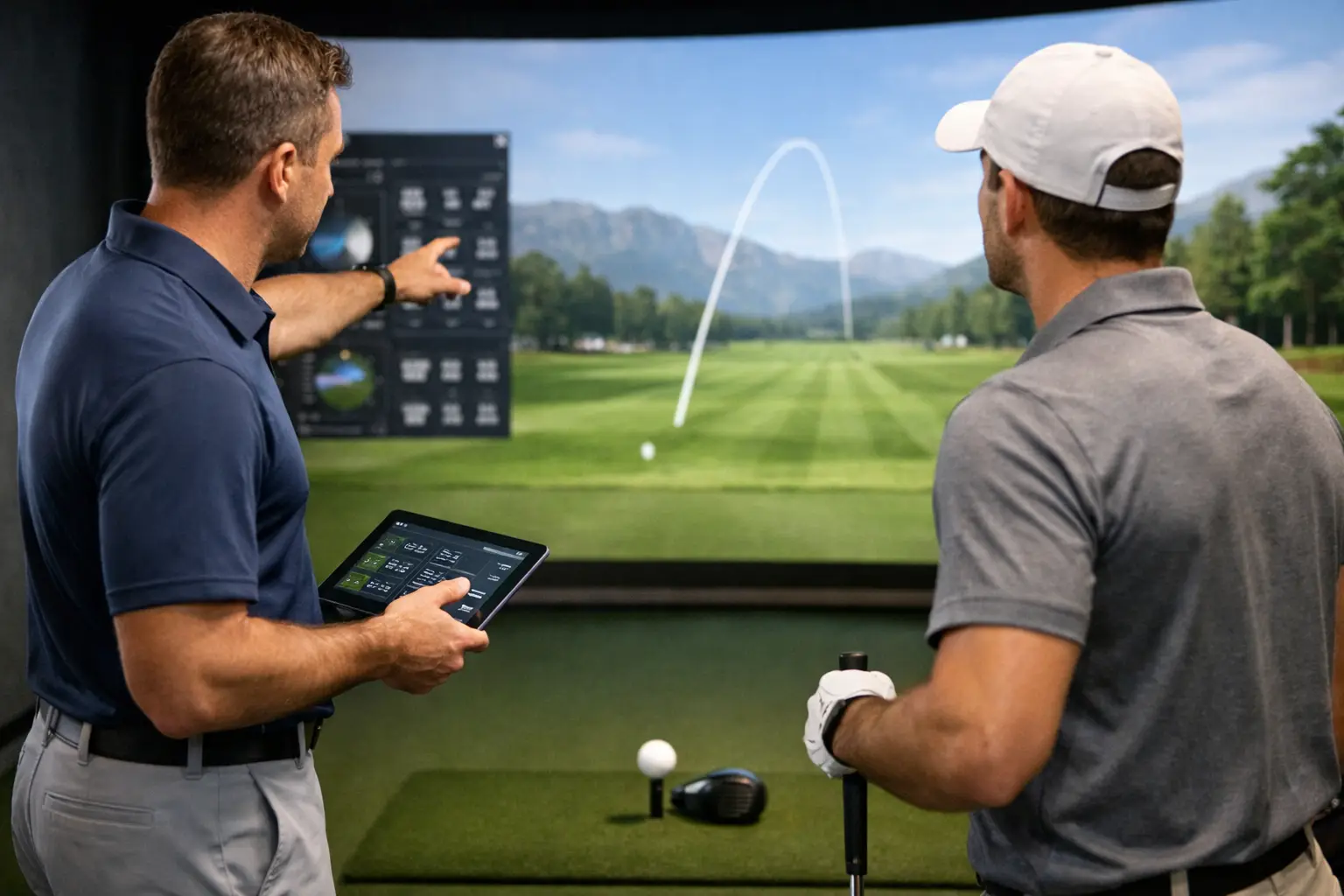
A seven-iron that feels pure but finishes 12 yards short is not a mystery when the numbers are on screen. It is a useful lesson. That is how simulator feedback lowers scores: it replaces assumptions with specific evidence, then gives golfers a repeatable place to act on it.
For many players, the issue is not effort. It is practicing without knowing whether a miss came from strike quality, club delivery, face control, launch, or an unrealistic target choice. Advanced simulator technology makes those distinctions visible in seconds. Used with purpose, that information can turn a frustrating range session into a plan for better scoring.
How Simulator Feedback Lowers Scores on the Course
A simulator does not lower a handicap by itself. Better decisions and more reliable shots do. The value of feedback is that it shortens the distance between a result and the reason behind it.
Consider the golfer who regularly misses approach shots right. Without data, the answer may be to aim farther left, change the grip, or simply swing harder. With shot feedback, that golfer can see whether the clubface is open at impact, the path is moving too far left, contact is drifting toward the heel, or the ball is launching with too much spin. Those are different problems with different solutions.
That clarity matters because random adjustments often create a second miss while trying to solve the first. A focused practice session, by contrast, can isolate one pattern, test one change, and measure whether it actually improves start line, carry distance, dispersion, or strike location.
The scorecard benefits show up in practical ways: fewer penalty shots, more predictable distances into greens, safer targets from uneven lies, and fewer short-sided misses around the green. Golfers do not need perfect swings to score better. They need a clearer picture of what their normal swing produces and a game plan that respects it.
The Data That Matters Most for Better Golf
More information is not automatically better. The most useful metrics are the ones that answer a question a golfer can act on during practice or play.
Carry Distance Builds Better Club Selection
Carry distance is often more valuable than total distance. A ball may roll out 15 extra yards on a firm fairway, but it still needs enough carry to clear a bunker, water hazard, or front edge of a green. Knowing a reliable carry number for each club makes course management more precise.
Simulator sessions also expose the gap between a golfer’s favorite number and their actual average. If a seven-iron occasionally carries 165 yards but normally carries 153, choosing it for a 160-yard forced carry is a gamble. A lower score often starts with accepting the average and choosing the club that covers the trouble.
Face, Path, and Impact Explain Ball Flight
Ball flight tells a story, but it does not always identify the cause. A fade can be a controlled shot shape or the result of a face that is too open relative to the swing path. High-speed impact cameras and detailed club-and-ball data help separate intention from accident.
At 24 Precision Golf, Golfzon TwoVisionNX technology gives players a highly detailed view of how the ball reacts at impact. That means a player working on a slice, hook, or inconsistent start line can measure progress rather than rely solely on feel. Feel still matters, but it becomes more valuable when it is connected to a verified result.
Dispersion Is More Useful Than the Occasional Perfect Shot
Golfers naturally remember their best shots. Scores are usually shaped by the shots that miss. Dispersion data shows the full pattern: how far left and right shots finish, whether misses tend to come up short, and how the pattern changes with different clubs.
This is where simulator practice becomes a course-management advantage. If a player’s typical eight-iron pattern is 10 yards right of target, attacking a tucked right pin may be the wrong play. Aiming at the center of the green or choosing a more conservative target protects par without requiring a technical swing change.
Realistic Conditions Make Feedback More Transferable
Useful feedback needs context. Hitting every shot from a perfectly flat mat can help build a swing, but golf rarely offers perfect lies. The transition from controlled practice to an actual course is stronger when the practice environment asks the golfer to adapt.
Moving swing plates and multi-surface hitting mats create meaningful variation. An uphill lie can add loft and encourage a different strike. A downhill lie can shift the ball’s launch and influence balance. Rough, fairway, and bunker-style conditions call for different expectations around contact and spin.
That realism is not a gimmick. It helps golfers learn what happens when a dependable range swing meets an imperfect lie. Instead of discovering those changes during a weekend round, players can practice them indoors, see the results, and develop more confident responses.
There is still a trade-off. An indoor simulator cannot replicate every element of outdoor golf, including wind, changing turf firmness, or the visual pressure of a difficult tee shot. It should not replace on-course experience for golfers preparing for competition. It can, however, make outdoor rounds more productive by improving strike consistency, distance knowledge, and decision-making between rounds.
Turning a Simulator Session Into Lower Scores
The best simulator practice has a purpose before the first ball is hit. A player who wants to lower scores should avoid spending an entire session chasing maximum ball speed or replaying the same comfortable shot.
Start with one scoring problem. It might be approach shots from 120 to 160 yards, tee shots that miss one side of the fairway, or inconsistent distance control with wedges. Establish a baseline with several shots, not just one. Then make a single adjustment, whether that is a setup change, a target change, a different club, or a coach’s recommendation.
Watch the pattern over enough shots to matter. A swing change that produces one excellent ball and six poor ones is not ready for the course. A small adjustment that tightens dispersion and improves carry consistency is often far more valuable, even if it does not look dramatic.
Finish by creating a playable takeaway. For example: carry the 150-yard club over the front bunker, aim at the left-center of greens with a back-right pin, or use the hybrid off a narrow tee rather than forcing driver. These decisions translate directly to a scorecard.
Practice the Shots That Usually Cost Strokes
The full swing gets attention because it is measurable and satisfying. Yet many golfers can make faster scoring gains by using simulator feedback to sharpen wedges, recovery shots, and tee-shot strategy.
A wedge session should not be limited to full swings at a single number. Test partial swings, different trajectories, and landing zones. Learn what produces a controlled 40-yard, 60-yard, and 80-yard carry. The goal is not to manufacture every shot in the bag. It is to own a few dependable options when a missed green leaves a difficult distance.
Tee shots deserve the same discipline. A simulator can show whether a driver really creates a scoring advantage on a narrow hole or whether a fairway wood produces a much tighter pattern with only a modest distance sacrifice. The right answer depends on the hole, the player’s confidence, and the penalty for a miss. Better golfers are not always more aggressive. They are more accurate about risk.
Pair Technology With Expert Coaching
Data identifies patterns. A skilled instructor helps decide which pattern is worth changing first and how to change it without creating confusion. That partnership is especially useful for golfers who see several numbers moving at once and are tempted to fix everything.
PGA professional instruction can turn a simulator report into a priority-based practice plan. Perhaps the main issue is low-face contact, not swing path. Perhaps the golfer’s distance problem is a poor strike pattern rather than a lack of speed. Perhaps the swing is functional, but target selection is costing more shots than mechanics.
For beginners, this guidance keeps feedback from becoming overwhelming. For experienced players, it creates accountability and a cleaner way to test performance changes. The technology provides precision; coaching gives that precision direction.
The next time a shot finishes somewhere unexpected, resist the urge to label it bad and move on. Use the feedback to ask a better question: What happened, and what is the simplest adjustment that improves the next ten shots? That habit is where meaningful score improvement begins.