How Realistic Golf Simulator Lies Improve Practice
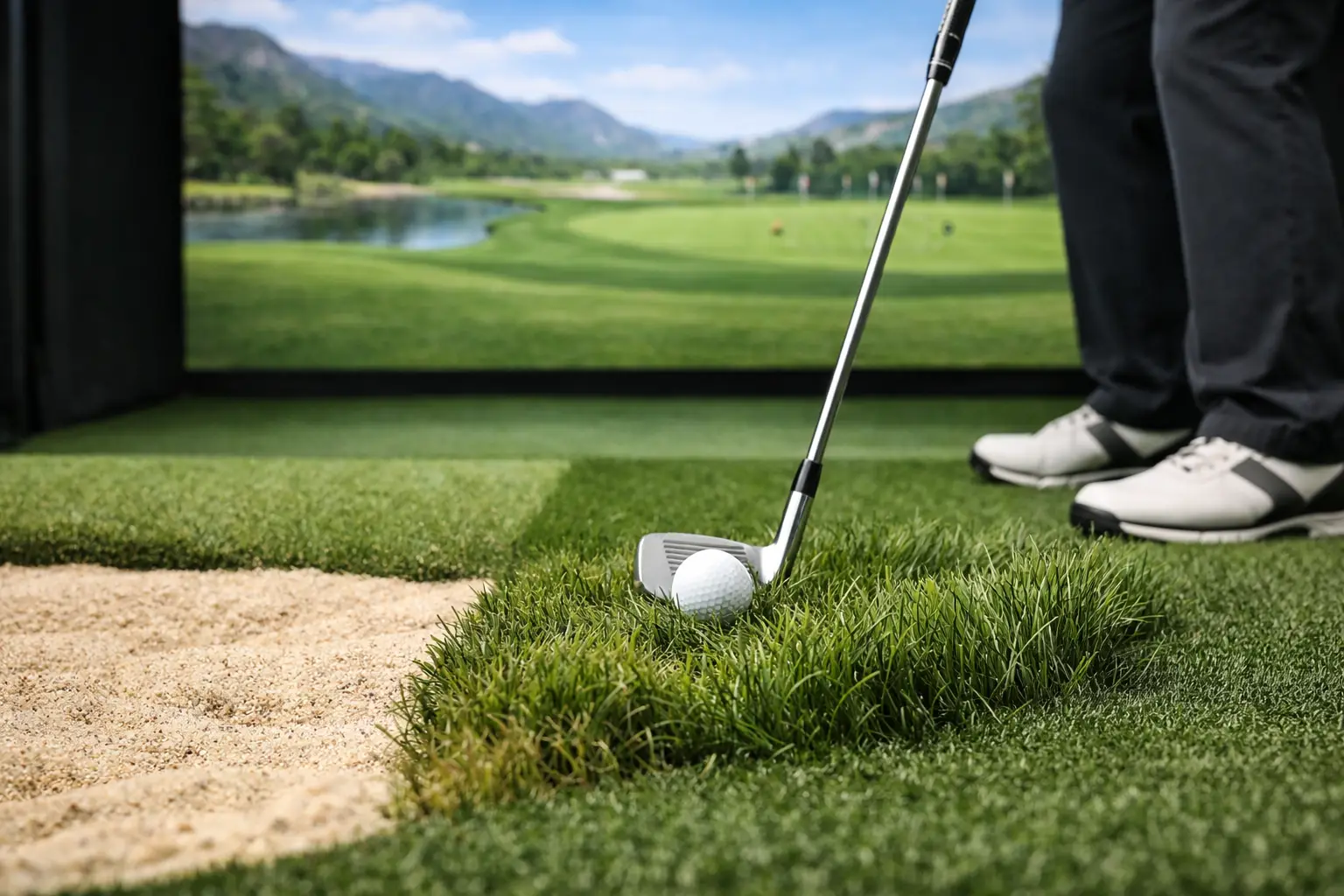
A perfect, level lie can make almost anyone feel like a better ball striker. It can also hide the reason a swing falls apart on the course. Realistic golf simulator lies change that equation by asking players to handle the same visual and physical decisions they face outdoors: uphill and downhill stances, sidehill ball positions, rough, fairway bunkers, and uneven ground.
For golfers who want more than a screen and a shot total, lie realism is one of the clearest differences between a simulator built for performance and one built mainly for entertainment. The goal is not to make indoor golf harder for its own sake. It is to make practice honest, repeatable, and useful when the next round puts the ball somewhere less than ideal.
What Realistic Golf Simulator Lies Actually Mean
A realistic simulator lie is not just a picture of grass, sand, or rough projected on the screen. The best systems pair course visuals with a physical setup that changes how a golfer must stand, swing, and strike the ball.
At 24 Precision Golf, Golfzon TwoVisionNX technology uses a moving swing plate and multi-surface hitting mat to recreate the conditions represented by the virtual course. If a ball finishes above or below your feet, the platform adjusts. If your shot lands in a bunker or rough, the hitting surface changes to reflect that lie. That physical response matters because golf is played from the ground up.
The simulator also reads the result of the shot with high-speed impact cameras and detailed ball data. You are not guessing whether your adjusted setup worked. You can see how club path, face angle, launch, spin, and strike quality translated into the shot.
No indoor system can reproduce every variable of a live course. Natural turf thickness changes, sand can be fluffy or compact, and weather affects both club and ball. Still, a simulator that physically changes the lie delivers a much closer training environment than striking every shot from a flat, identical mat.
Why Flat-Mat Practice Has Limits
Standard hitting mats are useful for grooving contact and working on a repeatable full swing. They are also forgiving. A mat can allow the club to slide through impact when a fat shot on grass would lose speed, shut the face, or come up well short.
That does not make flat-mat practice worthless. It simply means players should understand what it can and cannot teach. If every ball is teed up at the same height on the same level surface, practice may reinforce confidence without preparing you for the awkward shots that decide real rounds.
Consider a common approach shot from a sidehill lie. With the ball above your feet, the club effectively plays shorter and the face may point left of the target. With the ball below your feet, balance becomes more demanding and the club can play longer. Those are not details a golfer can fully learn by aiming at a simulated sloped fairway while standing on a level platform.
Realistic lie conditions bring the body into the decision. Players must adjust posture, maintain balance, choose a target, and make a committed swing. That is where the transfer from indoor training to outdoor golf becomes much stronger.
The Skills You Build From Uneven Lies
Better Setup Before the Swing
Most lie-related mistakes happen before the club starts back. A moving plate makes setup impossible to ignore. On an uphill lie, you may need to match your shoulders to the slope and anticipate a higher launch. On a downhill lie, staying balanced and accepting a lower trajectory can be the smarter play.
Practicing these positions indoors gives golfers time to slow down, recognize the pattern, and repeat it. The next time an approach finds an uneven fairway, the situation feels familiar rather than disruptive.
More Reliable Distance Control
A 150-yard number does not always call for a stock 150-yard swing. Slopes influence strike, launch, and face angle. Rough can reduce spin and make the ball jump. Sand changes how the club moves through impact. Realistic lie conditions teach a more valuable question than, “What club do I hit from this yardage?” They teach, “What shot can I reliably produce from this lie?”
That distinction benefits every level of golfer. Beginners learn why course management matters. Better players can test specific adjustments and build a more dependable decision-making process under pressure.
Stronger Balance and Lower-Body Control
Uneven stances expose rushed tempo and unstable posture quickly. A golfer who can maintain pressure, stay centered, and finish in balance on a tilted platform is developing athletic control that carries into live play.
This is particularly useful for players who practice primarily indoors during Arizona’s hottest months. Instead of putting full-swing work on hold, they can continue training on a surface that demands more than a perfectly flat driving-range stance.
Rough and Sand Should Change the Shot
Visual course realism is enjoyable, but surface realism is where a simulator becomes a better practice tool. A rough lie should encourage the golfer to think about grass resistance, reduced control, and a more conservative target. A bunker lie should require a different interaction with the surface than a clean fairway strike.
Multi-surface mats cannot perfectly duplicate every grain of Bermuda or every bunker texture. They can, however, create a meaningful change in feel and expectation. That is enough to improve the quality of practice. Instead of treating every virtual lie like a clean fairway shot, golfers learn to assess the situation and adjust their plan.
The same principle applies to short-game practice. A player who spends time from simulated fringe, rough, and sand develops a wider library of shots than someone who only hits identical chips from a single mat. Repetition still matters, but varied repetition is what makes a skill more adaptable.
Realism Is Valuable, but It Is Not the Only Factor
The most realistic golf simulator lies are valuable only when the technology is accurate, the environment is well maintained, and the player uses the feedback with purpose. A moving platform does not fix an open clubface. A bunker mat does not replace learning proper technique. It creates a better setting to identify and improve those issues.
For technical changes, pairing simulator practice with PGA professional instruction can accelerate progress. A coach can separate a lie-related adjustment from a swing pattern that needs attention. For example, a player may assume every pushed shot from a ball-below-feet lie is unavoidable when their face control is actually the larger issue.
There is also a practical trade-off. The more a simulator reproduces course conditions, the less every shot feels automatic. That can be humbling for golfers accustomed to perfect indoor lies. It is also exactly why realistic systems are so effective for meaningful practice and competitive simulator rounds.
How to Practice With Realistic Golf Simulator Lies
Start by playing a full round rather than only hitting stock shots. Notice when the virtual course gives you an awkward stance, rough, or sand, then resist the urge to force a hero shot. Use the opportunity to make the same choice you would make outside: select a sensible target, choose the club that fits the lie, and prioritize solid contact.
Then dedicate a session to one condition at a time. Play several shots with the ball above your feet and pay attention to setup, alignment, start line, and strike. Repeat with the ball below your feet. Work through uphill and downhill lies, then compare your results with your normal flat-lie pattern. The data is helpful, but your body awareness matters just as much.
For competitive players, realistic lies add another layer to league play and tournaments. A virtual round becomes less about who can make the prettiest swing from a perfect mat and more about who can manage a golf course. That creates a more engaging experience for experienced golfers while giving newer players a practical introduction to course strategy.
The best simulator session should leave you with something specific to take to the course: a better setup cue, a smarter club-selection habit, or more confidence when the lie is not perfect. When practice includes the ground beneath your feet, your swing has a better chance of holding up everywhere else.
Sources and further reading
- TwoVisionNX simulator features GOLFZON
- GOLFZON simulator technology GOLFZON
- Technology at 24 Precision Golf 24 Precision Golf