
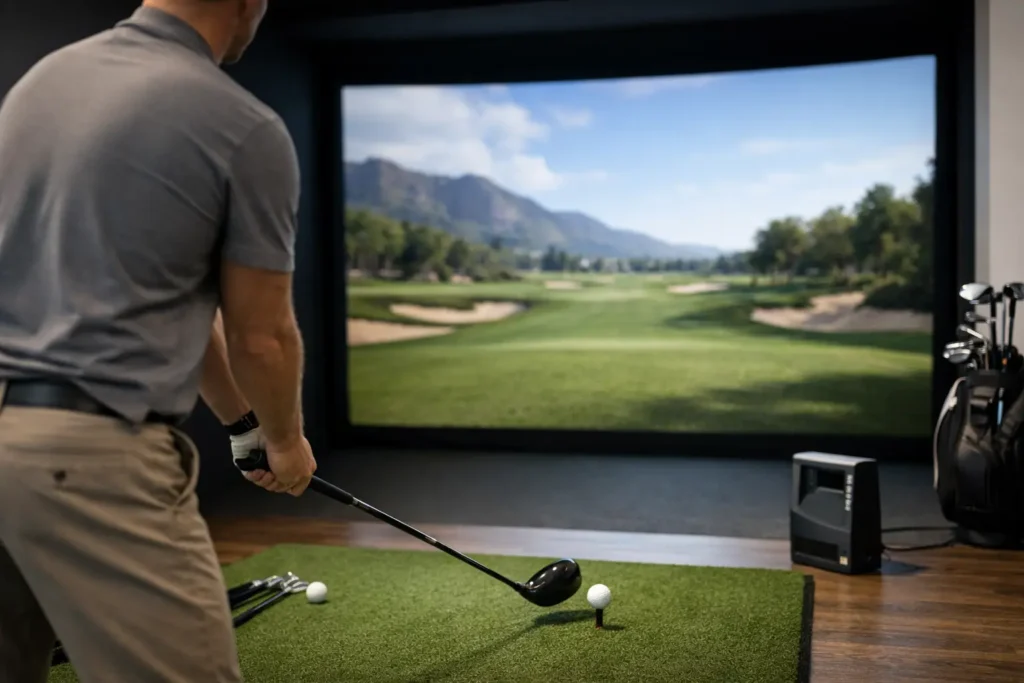
If a simulator says your 7-iron carried 182 when you know it was more like 168, everything after that starts to break down. Club gapping gets messy, practice loses value, and simulated rounds feel more like a video game than golf. That is why the search for the most accurate indoor golf simulator is really a search for trust – in the numbers, in the ball flight, and in the quality of the experience.
For serious players, accuracy is not a luxury feature. It is the difference between productive practice and expensive guesswork. For newer golfers, it matters just as much. Clean, reliable feedback helps you understand what your swing is doing without the confusion that comes from inconsistent reads. And for anyone who wants indoor golf to feel like real golf, accuracy is what makes the whole environment believable.
What makes the most accurate indoor golf simulator
The short answer is that accuracy comes from a combination of tracking quality, software intelligence, and physical realism. One great sensor alone does not create a great simulator. The best systems measure the right data, interpret it correctly, and recreate the shot in a way that feels true to what would happen on the course.
Ball data is where most players start, and for good reason. If a simulator cannot reliably capture launch angle, ball speed, spin, and direction, the rest of the shot model is on shaky ground. Club data matters too, especially for players working on path, face angle, and strike quality. But there is another layer that often gets overlooked – the hitting environment itself. If every lie feels flat and perfect, you are not getting a true golf experience, no matter how sophisticated the software looks on screen.
That is why premium simulator setups stand apart from entertainment-first venues. The goal is not just to show a ball flying across a screen. The goal is to reproduce the conditions that shape real shots and give players feedback they can actually use.
Accuracy starts with how the shot is captured
Not all launch technology works the same way. Some systems rely primarily on radar, some on cameras, and some use a blend of methods. Each approach can work well, but indoor performance depends heavily on how the technology is implemented.
High-speed camera systems tend to excel indoors because they can capture the impact moment in detail. That matters for spin measurement, launch conditions, and strike analysis. When a system uses advanced cameras to read what the ball and club are doing right at impact, you usually get more dependable data in an enclosed environment than you would from a setup that needs more ball flight to estimate results.
This is where premium technology makes a measurable difference. A simulator equipped with high-speed impact cameras, especially in the 400 FPS range, can read the shot with far more precision than a basic consumer setup. You are not just seeing a projected outcome. You are getting a much clearer picture of what actually happened.
That precision pays off in practical ways. Yardages become more trustworthy. Dispersion patterns start to mean something. You can test clubs, compare swing changes, and work through lessons with confidence that the numbers reflect reality.
Ball data matters more than flashy graphics
A simulator can have beautiful course visuals and still be a poor training tool. If the spin numbers are off or side axis is inconsistent, the shot shape on screen may look convincing while telling you the wrong story.
The best systems prioritize measured data first and visuals second. That does not mean graphics are unimportant. Realistic visuals absolutely improve immersion and make rounds more enjoyable. But if you are evaluating the most accurate indoor golf simulator, clean ball data should outrank cinematic presentation every time.
Good simulators also do not overcorrect your misses. If you hit a weak fade, it should stay a weak fade. If you catch one heavy or off the toe, the result should reflect that. Accuracy is not about making the player look better. It is about making the player better informed.
Realism is part of accuracy too
Here is the part many buyers and players miss. A simulator can produce strong data and still fall short as a golf environment if every shot is played from the same ideal stance.
Real golf is not hit from a perfectly level mat every time. Lies change. Weight shifts differently on uneven ground. Certain swings become easier or harder depending on the slope and surface. If an indoor setup ignores that reality, the practice can become a little too clean.
That is why moving swing plates and multi-surface hitting mats are such important features in a premium facility. They bring physical realism into the equation. When the platform adjusts to simulate uphill, downhill, and sidehill lies, your body has to react the way it would outdoors. When the mat changes the feel underfoot and at impact, course simulation becomes far more than a visual effect.
This matters for training, but it also matters for entertainment. Simulated golf becomes more immersive when a bunker shot feels meaningfully different from a fairway shot. The round flows better, the challenge feels authentic, and players stay engaged because the experience asks for real adjustments.
Why auto-tee and faster play still matter
Accuracy is the headline feature, but premium simulator design also includes pace. Auto-tee systems may sound like a convenience item, yet they improve the experience in a real way. They keep play moving, reduce repetitive setup, and make group rounds feel polished instead of clunky.
That speed matters in lessons, practice sessions, leagues, and events. If players spend less time resetting and more time hitting, they get more reps and more usable feedback. In other words, the best indoor golf experience is not just accurate in isolated moments. It is consistent, efficient, and built to maintain rhythm.
The most accurate indoor golf simulator for different players
There is no single answer for every golfer because needs vary. A low-handicap player focused on distance control and shot shaping may care most about precise spin and club delivery data. A beginner may value clear ball flight feedback and an environment that makes learning less intimidating. A parent looking into junior development may want both reliable technology and structured coaching support.
That is why the right simulator is often tied to the setting around it. Hardware matters, but so does how it is used. In a premium indoor facility, the simulator becomes part of a larger performance system – one that can include instruction, purposeful practice, league competition, and repeatable progress tracking.
For many golfers, that is more valuable than owning a launch monitor at home. A home setup can be convenient, but it usually involves trade-offs in space, calibration, slope simulation, hitting surface quality, and software depth. A professional environment tends to deliver a more complete version of simulator golf, especially for players who want realism and accountability.
How to judge simulator accuracy before you book
If you are trying to compare venues or technologies, look beyond marketing language. Ask what kind of shot data is actually measured. Find out whether the system uses high-speed cameras, whether it captures both ball and club information, and whether the hitting environment changes to reflect real lies.
Then pay attention to the player experience. Does the simulator reward thin contact too generously? Do mishits all seem to fly strangely similar distances? Does every shot come from a flat stance? Those are signs that the setup may be more about casual entertainment than serious realism.
On the other hand, when a simulator combines advanced camera tracking, moving swing plates, realistic hitting surfaces, and strong software, the difference is obvious. Shot patterns tighten or widen in believable ways. Bad swings produce bad outcomes. Good swings feel earned. Practice starts to carry over.
A facility built around systems like Golfzon’s TwoVisionNX has an edge here because it is designed for more than screen golf. Features such as moving swing plates, high-speed impact cameras, auto-tee functionality, and multi-surface mats create a more complete indoor golf environment. For players who want realism with performance value, that kind of setup is where simulator accuracy starts to feel truly useful.
Why accurate simulation changes the way people use indoor golf
When players trust the data, they use simulators differently. Practice becomes more focused. Lessons become more efficient. Leagues become more competitive because results feel legitimate. Even casual rounds are better because there is less of that quiet doubt about whether the technology is making things up.
That trust is also what makes year-round indoor golf such a strong option in a market like the Phoenix metro area. You are not just escaping heat or bad weather. You are getting access to a controlled environment where performance can actually be measured, refined, and enjoyed on your schedule.
The best simulator experience does not force you to choose between serious improvement and a great time. It gives you both. If you are evaluating options, look for the setup that respects the details of real golf – because once the numbers feel believable, every swing has a lot more value.