What Is a Moving Swing Plate in Golf Simulators?
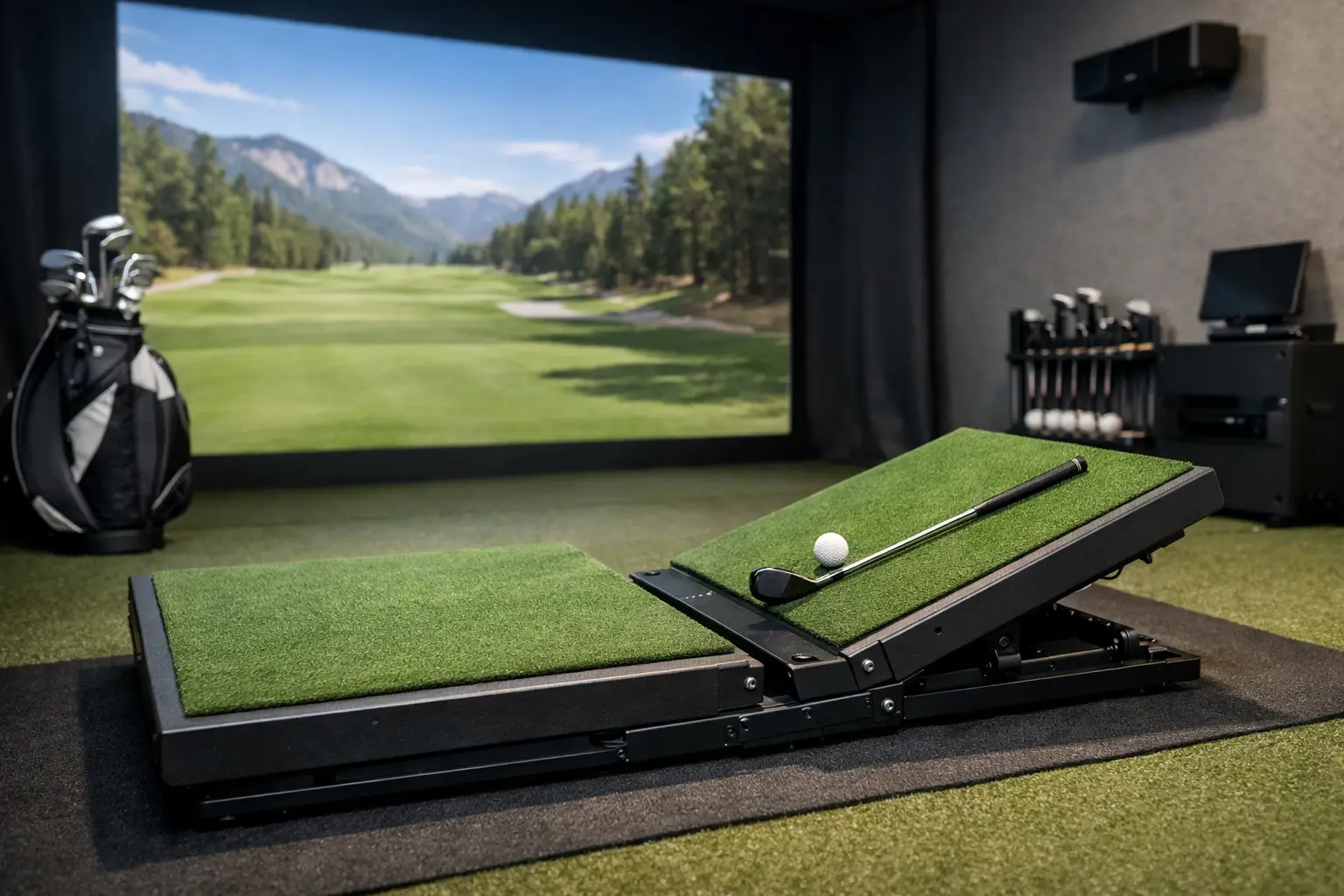
A level mat can tell you where your shot finished. It cannot tell you how your swing holds up when the ball is above your feet, your stance is pitched downhill, or the fairway falls away toward the green. So, what is a moving swing plate? It is the adjustable hitting platform in a premium golf simulator that changes the slope beneath your feet to match the lie shown on the virtual course.
For golfers who want more than a scorecard and a screen, that difference is substantial. A moving swing plate turns each shot into a more complete decision: read the lie, adapt your setup, make the swing, and see the result. It brings a piece of on-course golf indoors without sacrificing the convenience of fast, weather-proof play.
What Is a Moving Swing Plate?
A moving swing plate is a motorized platform built into the simulator hitting area. When your virtual ball finishes on an uneven lie, the plate tilts and adjusts under the hitting mat to recreate that slope for your next shot. Depending on the simulator system and the course situation, it can place you on an uphill, downhill, ball-above-feet, or ball-below-feet lie, including combinations of those slopes.
The technology is designed to translate course terrain into a physical stance condition. Instead of simply seeing that your ball is on a sidehill lie, you feel the sidehill lie before you swing. That added feedback changes alignment, balance, club selection, and the way you plan the shot.
At 24 Precision Golf, the Golfzon TwoVisionNX simulator pairs this moving platform technology with detailed course visuals, high-speed impact cameras, and realistic hitting surfaces. The goal is not to make a simulator round harder for the sake of it. It is to make the feedback more representative of the golf you play outdoors.
How a Moving Swing Plate Changes the Shot
Golf is not played from a perfectly flat surface very often. On a real course, a small change in slope can alter how a player aims, how the club travels through impact, and where the ball starts. A moving swing plate makes those changes part of the simulator experience rather than a visual detail you are asked to imagine.
It recreates stance pressure and balance
On an uphill lie, players naturally feel more pressure toward their trail side and may need to adjust posture to stay balanced. On a downhill lie, maintaining posture and finishing the swing can become more demanding. A sidehill lie can pull your balance toward or away from the ball, changing where the club contacts the turf and how the face delivers through impact.
A simulator cannot reproduce every variable of outdoor golf, such as wet grass, loose footing, or an awkward tree root. But physically changing the stance platform captures one of the most meaningful variables: the relationship between your body, the ball, and the slope.
It makes course management more honest
A flat-mat simulator can make a difficult approach look straightforward. You may have 145 yards left, but that number alone does not describe the shot if the ball is sitting on a severe downslope or above your feet. With a moving swing plate, the lie has a practical effect on execution.
That encourages better decisions. A confident player may still attack a pin from a demanding stance. Another player may choose a safer target, take more club, or play for the center of the green. Those are the choices that separate simply striking shots from managing a golf course.
It provides more useful practice feedback
If you are working on consistency, practicing only from a flat lie can hide weaknesses. A moving plate exposes whether your posture, tempo, and low point control remain reliable when the ground changes. The shot data matters, but so does the physical reason behind it.
For example, a player who repeatedly misses right from a ball-below-feet lie can use that pattern to refine alignment and balance with a PGA professional. The plate does not replace coaching, but it gives instruction a more realistic setting. You can rehearse the adjustment, see the ball flight, and repeat the situation without waiting for the same lie to appear on a course.
The Lie Types You Can Expect
Most moving swing plate systems are built to simulate the core slopes golfers encounter during a round. The exact range of motion varies by simulator model, but the experience typically includes uphill, downhill, left-side-high, and right-side-high stances. More advanced systems can blend those directions, creating a more natural representation of rolling fairways and uneven approach areas.
An uphill stance tends to encourage a higher launch and can influence how the player sets the shoulders and clubface. A downhill stance often asks for more control through the strike and can make solid contact less automatic. When the ball is above your feet, the club can sit closer to the body and the ball may tend to move left for a right-handed golfer. When it is below your feet, maintaining posture becomes the priority and the ball may tend to move right.
Those are common tendencies, not universal rules. Swing path, face control, flexibility, and the severity of the slope all matter. That is precisely why a moving swing plate is valuable: it lets players experience the adjustment rather than memorize a generic tip.
Moving Swing Plate vs. a Standard Simulator Mat
A standard simulator mat is still an effective tool for range sessions, shot analysis, and casual rounds. It is stable, familiar, and well suited to players who want a quick practice session or a relaxed game with friends. For many golfers, especially beginners, a flat hitting surface keeps the focus on basic contact and confidence.
A moving swing plate adds a different level of immersion. It asks the player to respond to the same kind of terrain changes that influence outdoor play. That makes it particularly valuable for golfers preparing for an event, sharpening on-course skills, or looking for a simulator round that feels more like a round of golf.
There is a trade-off. Uneven lies are more demanding, so scores may not look the same as they do on a flat-mat system. That is not a flaw in the experience. It is a more accurate reflection of why scoring outside requires more than a repeatable range swing.
Who Benefits Most From This Technology?
Competitive players and serious recreational golfers often appreciate the moving plate immediately because it adds context to every approach shot. They can test shot-making skills, learn how their tendencies change on slopes, and prepare for courses that rarely offer perfect lies.
It also has value for newer golfers. Beginners do not need to solve every slope perfectly, but exposure to realistic terrain helps them understand that setup and balance matter. With the right instruction, the platform becomes a practical learning tool instead of an intimidating complication.
For groups, leagues, and corporate events, the moving plate creates memorable moments without slowing down the experience. One shot may ask for a calm, controlled swing from an uphill stance; the next may put a friend on a sidehill lie with a forced carry over water. The technology adds variety and conversation while still keeping the round moving.
What to Do When the Plate Moves
The best response is not to overcomplicate your swing. Start by taking a moment to feel where your weight is naturally shifting. Set the club behind the ball, check your balance, and make an adjustment that matches the lie rather than fighting it.
For an uphill or downhill stance, focus on staying in your posture through impact. On sidehill lies, pay attention to the distance between your hands, body, and ball. A smaller, controlled swing is often a better answer than trying to force a full-speed shot from an awkward position.
If you are using the simulator for skill development, take note of the patterns instead of judging one swing. Do you lose balance on downhill lies? Do sidehill shots consistently start offline? Those observations create productive practice goals and give a coach something specific to address.
Why It Matters for Indoor Golf
The best indoor golf technology does more than display famous courses. It gives golfers meaningful input, credible feedback, and reasons to make smarter choices. A moving swing plate closes the gap between virtual terrain and physical execution, making the simulator useful for both performance training and more immersive play.
The next time the floor shifts beneath your feet before an approach shot, treat it as an opportunity rather than an obstacle. The lie is giving you a better question to answer – and every well-played response can make the next outdoor round feel a little more familiar.
Sources and further reading
- TwoVisionNX simulator features GOLFZON
- GOLFZON simulator technology GOLFZON
- Technology at 24 Precision Golf 24 Precision Golf